

Thanks to Tom Cochrane, we all know that Life is a Highway. While the Rascal Flatts cover made it a...
When you first branded, you might’ve picked colors that were recommended to you by an agency, a logo you thought performed best, and a website that was ahead of its time the year it was built. You launched a business and went live. It was credible enough to open the door, and functional while you figured out the rest.
Your brand did its job...for a while.
Then one day, you looked around and realized every business in your space looked the same. Same palettes. Same layouts. The same phrases about care, quality, or transformation. You scroll through competitors and can’t tell where one business ends and another begins.
Until you realize your brand sits in the exact same noise, even though the work you do feels clearly stronger than most of what else is out there.
Your referrals start drying up. Maybe prospects start to compare you to options that don’t come close to your level. You're spending too much time explaining why your brand is different, instead of having your brand speak for itself.
Small Business Rebrand When the Website Starts Killing Business Momentum
At some point along the way, you notice your website isn’t helping you stand out anymore.
It’s just sitting there. People click it, skim for ten seconds, and bounce. No email. No follow-up. No “I saw your site.” You don’t even know they were there.
You feel it indirectly when someone reaches out through a referral and still asks basic questions your site should’ve answered, or a lead ghosts after you send the link. A potential client says they “took a look” and then went quiet. Deals stall more often. Prospect conversations slow down.
Your service can be solid and your reputation impeccable, but your website isn't helping you. A rebrand should be considered when you realize the website isn’t bad enough to panic about, but it's become ineffective enough to impact your growth.
Beyond the Homepage: Why a Stagnant Brand Is a Symptom of Growth
You know the website is out of date when people reach out asking for things you stopped offering. They come in expecting scopes and prices you haven’t used in a long time. You spend the first part of the conversation correcting assumptions from outdated information before you can talk about the actual job.
But inside the business and you're day-to-day, you're running a tighter ship with shorter timelines and higher standards than ever before. You now know exactly where projects fall apart and you avoid those.
You're still losing time to small resets, clarifications, and conversations that loop. The website doesn’t create the mismatch, but it does keep repeating it.
The Psychology of the Pivot: Aligning Your Brand Identity With Your Expertise
In every business owners' life, you eventually stop defaulting to any advice you didn’t come up with yourself. Early on, you followed what agencies recommended, what competitors were doing, and what looked proven.
That all made sense when you didn’t yet know which decisions mattered most and which to avoid. After you’ve seen enough deals, enough projects, and enough failures, you have your process down to a science.
Since you don’t work the way you used to, you don't tolerate the same clients, price the same way you did before, and you certainly don’t deliver the same outcomes that you started by.
When your brand language hasn’t caught up, you’re left translating your own business in real time.
Once your business operates at a higher level, your brand can't still speak like it's new anymore. The brand reflects how you already decide, choose, and work every day. Stepping into your proper authority becomes a necessity to reach differentiation from the competition.
Visual Evolution: Why Looking "Professional" Makes You Disappear in Your Market
In crowded markets, repeated visual decisions happen constantly. Similar color palettes, interchangeable typography, and predictable layouts show up across logos, proposals, social posts, pitch decks, and internal documents, until strong businesses occupy the same visual category as weaker ones. The brand becomes easier to group, easier to skim past, and harder to describe.
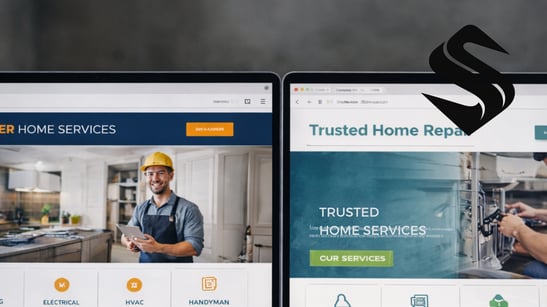
Home services companies are an easy example. House logos. Blue, white, red. The same standard look carrying from trucks to websites to invoices.
Typography follows the same pattern across long documents, short posts, and shared files. Layouts settle into a format changes, platforms, and distribution channels.
By the time someone lands on the brand, most assumptions are already formed.
Refining the Narrative: Giving Your Brand a Voice That Cuts Through Nonsense
Most brands run on language you inherited. There's always old positioning decks, copied competitor phrasing, agency questionnaires, and early intake forms circulating through your bios, proposals, service pages, and captions. You read your own copy and everything has shifted since it was first created, narrating an older version of you and your processes that no longer exists.
As the business matures, you'll see it show up in conversations when you have to repeatedly clarify scope before you talk about the work. You restate boundaries you already clearly enforce. You answer questions your materials should have handled. The brand voice trails behind the decisions you make every other week, turning routine exchanges into small negotiations that eat time and thin your authority.
Refining the branding means tightening language around how you actually work. The words match how you choose clients, how projects take shape, who gets access, and what conditions guide outcomes. Nothing reaches for broad appeal. Everything reflects the way you already decide and deliver.
When that language stays consistent across every touchpoint, fewer people arrive misaligned. Conversations hold their line. Explanations fall away. You spend less time translating your business and more time doing the work it was built to support.
Infrastructure for Growth: Preparing Your Business for Your Next Tier
As your business grows, weak systems show up in your day instead of nicely on a dashboard.
Client details live in your inbox, your notes app, old forms, half-finished docs, and your head. Follow-ups depend on remembering who needed what and when. Delivery leans on you catching things before they slip, which makes growth harder.
(This is usually the point where founders move client data, follow-ups, and communication into a CRM like HubSpot.)
Systems and infrastructure changes how you work. Client information sits in one place you can trust. Intake gives context before you even speak. Communication lives in one place instead of jumping from text to email, and back again. Publishing, scheduling, and service systems hold continuity so you don’t have to. The business moves from being remembered to being visible.
When the back end branding matches how seriously you take your work, your days become more focused. Clients hear from you on time without doing too much extra work. Decisions come from clear records instead of mental load.
More clear branding helps make every part of your business more clear.
Small Business Rebranding: The Cost of Outgrowing Your Brand Identity
When your systems work seamlessly, your expertise is honed, and your visual language is disciplined, the business runs smoother.
You aren’t just looking for a new logo or a fresh coat of paint on a homepage. You’re looking to close the gap between the powerhouse business you’ve built behind the scenes and the outdated version of you that currently exists in the public eye.
If you’re spending more time correcting the past than building the future—it's time for a rebrand. Selkire can help set you up for success.