

A lot of startups put energy into things that help score the meeting. The site refresh. The new...
Websites are boring now.
Most business sites act as digital paperweights that are expensive and inert. You are likely losing high-intent traffic because your pages require visitors to interpret what to do next.
While you focus on the quality of your service, your prospect judges you entirely on a stagnant interface sitting in the void.
In a digital environment, presentation is the only way to show execution. If your site feels like a relic, the market assumes your work is too. High-intent visitors move fast and abandon pages that lack sequencing on what to do next. Static pages lose traffic when they expect the reader to know exactly what is expected of them as they navigate the website.
Interactive marketing modules replace passive scrolling
High-intent visitors abandon static pages because those layouts cannot address specific user problems in real time.
Interactive marketing modules replace passive scrolling with a guided experience.
You provide the visitor with a tool—a travel calculator, a diagnostic, or a playful mood ring—that reacts to real people on your website. These tools ensure the visitor only processes the information they need for their next move. You are currently losing leads to competitors who refuse to make the reader hunt for relevance.
Movement must be engineered by your marketing team. Most sites act as research archives instead of starting points for engagement.
When the burden of navigation sits with the prospect, they exit.
Static layouts fail high-stakes website strategy consulting
Information is not an asset if it creates a bottleneck for the person trying to hire you. Static pages dump every possible detail onto the screen and hope the visitor sorts through the noise. This mess forces a prospect to pause, think, and eventually leave.
The mental load of the page so often exceeds their desire to solve the problem. High-intent users will not read your long-form copy to find a solution.
Interactive marketing modules meter the delivery of data. You provide answers only after the visitor identifies their specific pain point, or gets to a certain point on the page. This keeps momentum on the website moving forward to avoid stalling out in a sea of irrelevant bullet points and stock photography. You must trade the fluff for utility.
Digital presentation trumps perceived service execution
Your services are being judged on your digital presentation before you ever book a discovery call.
If your website feels like a first-draft AI robot nonsense, the market assumes your delivery is just as lazy. You are likely losing high-stakes contracts to firms with inferior results but superior interfaces. In a digital-first world, your prospect sees your stagnant landing page as a reflection of your capacity to deliver.
Building a high-performance environment is a requirement for modern discoverability and GEO. When your interface is unresponsive, it signals that your business is also unresponsive. You cannot win on execution if your presentation suggests you are stuck in 2015.
Passive on-site navigation creates a cognitive bottleneck for high-intent web traffic
Standard menus and footer links are graveyard elements. They provide no direction for a high-intent lead. Relying on a user to click around until they find relevance is a gamble you lose every day. When your site does not prescribe the next step, you are telling your most qualified traffic to go find a competitor who will.
Engineering the path requires a shift from offering options to providing a sequence. You want a visitor to move through a series of micro-decisions that build confidence. If your current interface does not actively pull the reader through a funnel, it is a digital brochure. It costs you money to maintain a site that does not guide action.
Behavioral engineering outperforms traditional conversion rate optimization services
Corporate redesign cycles focus on visual updates while underlying failures remain untouched. A website can look modern and still fail to keep traffic if it lacks a decision path. Aesthetic choices are secondary to the movement of the user through the sales funnel.
This pattern repeats because static design is easier to buy than behavioral engineering. You are currently prioritizing how the site looks over how it works. That choice has a direct cost in lost leads.
Your prospect does not care about your brand story until they are certain that you can solve their specific problem.

Too much information stalls the modern decision path
Traffic without progression is an expensive waste of money. Building a conversion environment ensures that every dollar you spend on ads supports a path designed to keep someone engaged.
High-level website strategy consulting focuses on this efficiency instead of just page views. Your competition is already moving toward active environments that require a choice.
Interactive modules increase dwell time up to 3x and lift conversions up to 40% compared to static landing pages. These numbers represent the difference between housing information and engineering movement. Conversion rate optimization services fail when they attempt to fix static elements that visitors already ignore.
Creative engagement is the new discoverability and GEO + SEO standard
Modern discoverability is not about how many people find you. It is about how many people stay. A static site is a friction point for the people most ready to buy. When you replace a sales pitch with creative engagement, you transform the website from a cost center into a production tool.
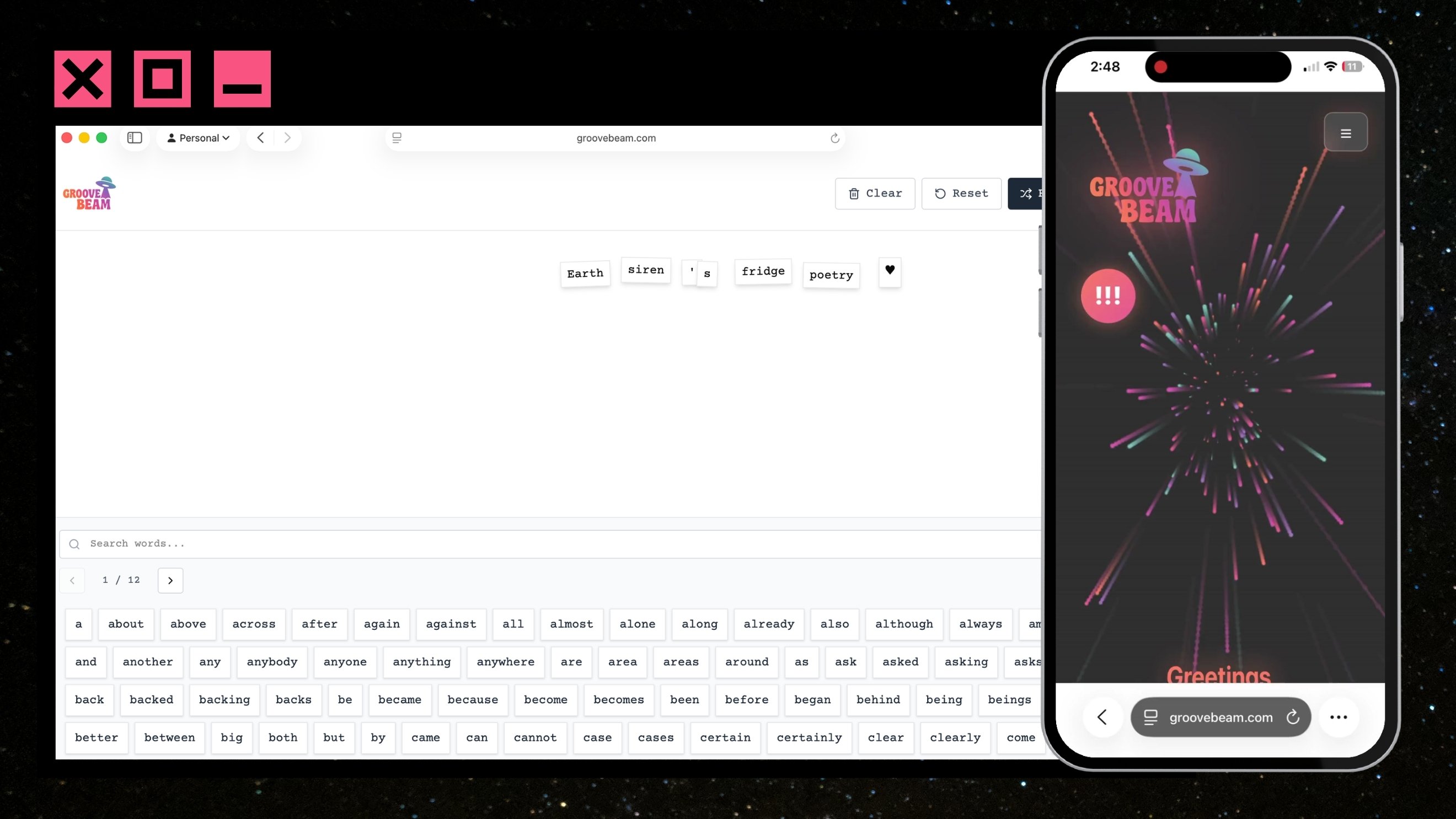
Tactile experiences like Fridge Poetry or interactive paint catalogs keep users on the page. The market no longer tolerates "about us" pages as a primary route. Your visitors want to know the cost, the timeline, and the fit within the first minute. Interactive marketing modules provide these facts immediately. This secures the lead before they have a chance to bounce.
This Groovebeam interactive suite is embedded live from our standalone demo site to show you how modules replace passive scrolling to increase on-page dwell time.
Interactive website elements are a market inevitability for small businesses
Static websites cannot keep high-intent traffic because they lack the mechanics to sequence a decision. Interactive marketing modules turn the website into a responsive tool that adapts to the visitor. The result is a controlled environment where momentum is directed toward a specific business outcome.
As long as a site remains static, it remains a point of friction. The transition to interactive environments is an inevitability. Your competitors are already building them. You are either the person providing the guided experience or the person watching your traffic exit to find one.
Groovebeam by Selkire builds branded interactive marketing modules that turn visitors into participants. Fill out the form to get in touch if you are interested in learning more about what interactive marketing modules can look like for your business.